Work / Research & Communication
A Conflict of Meaning
California Rangeland Trust wanted to raise private money to conserve working ranches. But before we could persuade people to support the mission, we had to confront an uncomfortable possibility: the people we needed to reach weren’t the people we were talking to. And the same words meant different things to different people.
.
Objective
When I joined the California Rangeland Trust (CRT), the organization was in the middle of a pretty big change. Historically, CRT had relied almost entirely on government grants to conserve working ranches. Now it wanted to build the outreach and philanthropy side of the organization and raise private money.
There was an obvious problem.
Most Californians had no idea who we were. A lot of them didn’t particularly understand ranching, either.
CRT had good reason to think about this. A similar organization in Colorado had just conducted a study on how to communicate with people outside the ranching community.
One of the findings was painfully simple: ranchers were very good at explaining why ranching mattered to other ranchers. They weren’t nearly as good at explaining why it should matter to everyone else.
So I started looking at who CRT was actually talking to. The answer was mostly people who already liked us.
Our events, newsletter, Facebook page, partnerships and personal networks overwhelmingly reached ranchers, western enthusiasts, agricultural organizations and existing supporters.
I mapped the audiences CRT was actually reaching against the audiences it needed to reach. The problem became obvious: we were largely talking to ourselves.
Almost everything clustered at one end.
My conclusion in the communications plan wasn’t particularly diplomatic:
Current activities focused almost exclusively on maintaining current supporters and “networking” within current social circle.
We wanted private donors. We were talking to ourselves.
INSIGHT
“The public” isn’t an audience.
Someone who hunts on ranchland isn’t starting from the same place as someone who works in downtown Sacramento.
A western enthusiast doesn’t need the same introduction as an environmentalist. Someone who grew up around cattle isn’t going to hear the same thing as someone whose entire experience of agriculture comes through a grocery store and the news.
So I started breaking the audience apart.
Who were these people? What did they already care about? Who did they trust? What scared them? What did they want? Who already had their attention?
And what, exactly, did we want them to do?
The communications plan I developed started there and worked forward: identify the audience, identify the people who influence them, understand what matters to them, look at what already works, develop the message, create the content, distribute it, and then watch what happens.
Research wasn’t something we finished before communicating.
It stayed in the plan all year.
Because I was already running into another problem.
What we said wasn’t necessarily what they heard.
I actually drew this into the communications plan:
WHAT WE SAY → WHAT WE WANT → WHAT THEY HEAR → WHAT THEY DO
My deliberately obnoxious example was essentially:
We say: We’re great.
We want: Please like us, tell your friends about us and give us your money.
They hear: Blah blah blah.
They do: Tune out. Hit the back button. Unsubscribe.
It was funny because everybody has experienced it.
It was also a serious problem.
Agriculture has its own vocabulary. So does conservation.
Conservation easement. Working landscape. Ecosystem benefits. Watershed.
Perfectly ordinary words inside our world could be meaningless, loaded or just boring outside it. The Colorado research had already identified some of this. I added other research and what I was hearing in my own conversations with people outside agriculture.
But a list of good words and bad words only gets you so far.
I wanted to know what made somebody care.
Vision
Then I got a room full of people to help figure it out.
I was asked to present my communications plan to a group of supporters — the Legacy Council. As a result, I was asked to form a Messaging Task Force made up of CRT supporters who wanted to meet regularly to help work through some of these questions. This brain trust eventually moved from crafting messages to designing experiences and became a catalyst for further investment in the CRT’s communications work—including an additional $100,000 contribution.
At first, we did exactly what you’d expect a Messaging Task Force to do. We worked on messaging responding to common misconceptions. We wrote, rewrote and rewrote again. Cows are bad for the environment became grazing is green.
But somewhere along the way we began to move away from myth busting and education.
I started thinking about what had to happen before someone would ever take the action we wanted. So I created what I called a Belief to Action Conversion Funnel.
Before someone outside agriculture was going to support CRT, they would first have to accept that modern agriculture was fundamentally legitimate. Then that working ranches provided something worth protecting. Then that conservation easements could protect them. Then they needed to know CRT existed.
Only after all of that did following us, sharing something, donating, volunteering or advocating make much sense.
And donation wasn’t even the end. At the far end were people who understood the issue well enough and cared enough to carry it themselves.
Different people also entered the funnel at different places. Someone who already hunted, rode horses or grew up around agriculture didn’t need the same intervention as someone who thought cattle and immediately thought climate change.
That sounds obvious once you say it.
But it wasn’t how we had been communicating.
The Plan
Then someone suggested we stop talking so much.
One of the Task Force members made an observation that shifted the conversation:
Sometimes the best communication is an experience.
She talked about having kids lie in the grass. Let them feel it. Compare that with hot asphalt. Let them experience something instead of explaining it to them.
That opened a door. We had schoolchildren coming on ranch tours. Instead of asking only what information we wanted to give them, we started asking:
How do we want their lives to be different because they came here?
We brainstormed and then I set to work creating educational materials and programming for the tours. With the help of my team, we added interactive elements, including a ranch rodeo and a conservation activity. Kids got to rope a bucket and, on some ranches, herd goats on foot. They learned how managed large animal grazing increases the water holding capacity and pollution filtration of soil. Then they created their own landscape out of foil that they subsequently “polluted”. Where cattle grazed, they poked many holes in the foil. Last, they sprayed water over their landscape and watched the pollution move through their landscape.
Then I started overhearing things.
“Oh! Now I get why we’re going to Raley’s.”
“Cowboy up!”
The kids were asking more questions. They were engaging earlier. They got it.
They weren’t the only ones excited. Teachers saw science and math coming alive for their students and wanted more. They wanted curriculum. Unit studies. It was incredibly rewarding.
But we could only take so many students on these field trips.
Experiencing something worked better than explaining. But how could we scale what we learned on these ranch tours and give this experience to somebody we couldn’t physically bring to a ranch?
That’s how we ended up talking about virtual reality. And games. And interactive exhibits.
At one point we were designing a miniature watershed we could literally rain on. Visitors could put simulated pollution onto a model landscape with a city, ranch, wildlife and cattle. Then we’d make it “rain,” and they could watch where the water—and the pollution—went.
Next to it, somebody could sit in a saddle wearing a VR headset and experience ranch country.
This had wandered quite a long way from writing better Facebook posts.
what happened
From an apartment window to a barn.
In another conversation, someone described what we were trying to accomplish in a way that stuck with me. How could we get beyond the literal and create the kind of connection that brings the hair on the back of someone’s neck up?
How could we take someone mentally from an apartment window to somebody’s barn and make them want to be part of a world they didn’t yet understand—even if they never actually stepped foot on a ranch?
We didn’t just need people to know ranches existed. We wanted them to feel something.
And then came another question:
Once someone cares, how do you make them feel like they’re actually in the game?
That’s what private philanthropy ultimately asks.
Someone with no ownership in your organization—and perhaps no direct connection to the people or places you’re protecting—has to decide that the outcome belongs, in some small way, to them too.
But underneath all of this, we kept running into one stubborn problem.
We could use the same words and mean different things.
Two people could hear exactly the same word and react as though they’d heard two completely different things.
We knew it was happening. We didn’t really know what was happening underneath it.
By that point, we’d identified a problem much bigger than the one we’d started with. The audience map showed us how much of our communication circulated among people already connected to ranching. The belief-to-action framework gave us a way to think about what it might take to move someone from unfamiliarity to genuine support. And the Messaging Task Force had opened up possibilities that went well beyond sending out better information.
I left CRT without knowing where all those ideas would lead. But one question stayed with me: Even if we reached the right people, how could we be sure they understood what we meant?
A couple of years later, at Purdue, I finally had an opportunity to study it properly. For my graduate research at Purdue, I conducted ten qualitative interviews—four with agricultural professionals and six with consumers—to explore the associations people made with common agricultural terms.
I did something very simple.
I gave them the same words.
I gave them common agricultural and food terms and asked what they pictured or what immediately came to mind.
I followed their answers. The exercise was straightforward:
The answers were not.
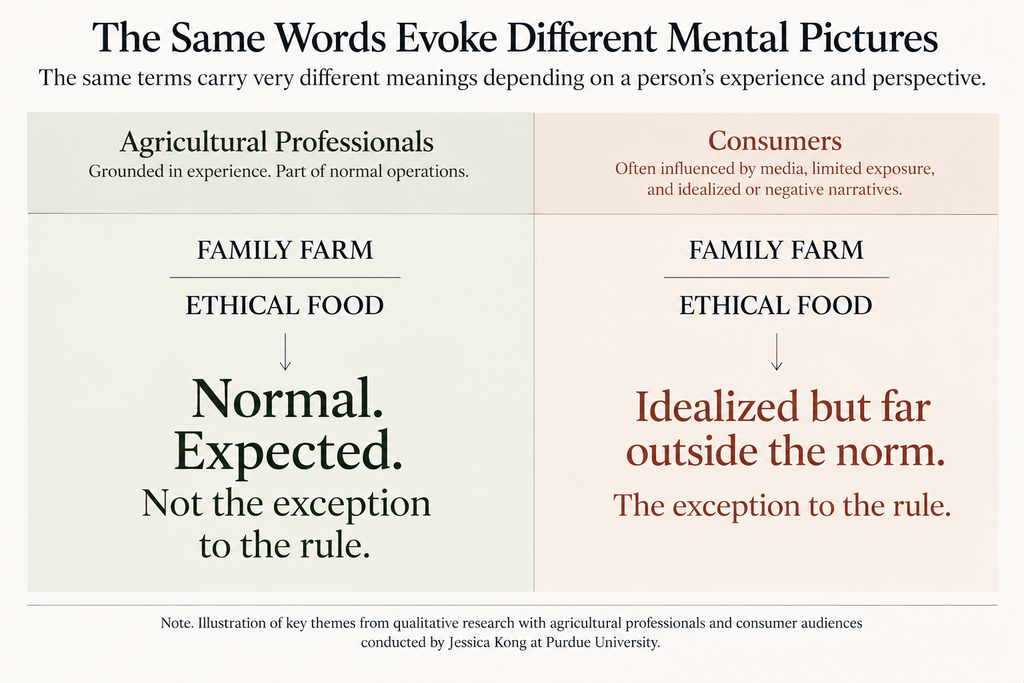
Take family farm.
Agricultural people tended to picture actual places. Family farms were normal. Their responses were concrete and often nostalgic.
Consumers’ pictures were more abstract. Some believed family farms were nearly extinct. The word “Agriculture” often immediately invoked corporations, climate change, victimization of small farms, and ethical concerns.
Then there was ethical food.
Agricultural professionals generally reacted as though ethical production were ordinary. Of course you take care of animals. Of course you have to manage your resources. A farm or ranch that destroys the resources it depends on isn’t going to stay in business very long.
Consumers tended to hear something different. “Ethical” suggested a special category—food produced differently from the norm.
And it kept happening.
The same word could enter two people’s heads and land in two different worlds.
That was the problem we’d been circling.
It wasn’t simply that people disagreed about agriculture. In some cases they were starting from completely different pictures of what agriculture was. That finding undermined one of the assumptions beneath the original communications problem at CRT. The question wasn’t simply whether CRT had found the right words. If the audience was constructing an entirely different meaning from those words, better messaging alone couldn’t solve the problem.
My final paper put it more academically: communication falls apart when the message someone thinks they’re sending isn’t the message the other person receives.
Which was a much nicer way of saying:
What we say isn’t necessarily what they hear.
We’d come full circle.
Then the research handed me another problem.
I asked people who they trusted. For consumers, the strongest answer was small farmers.
Not labels. Not the news. Small farmers.
Great.
There’s the answer.
Have small farmers tell agriculture’s story.
Except…
Small farmers are busy farming.
Most aren’t public-facing retailers. They produce wholesale products. They don’t necessarily have spare employees, communications departments, marketing budgets or hours every week to explain agriculture to strangers.
And trusting my farmer doesn’t necessarily mean I suddenly trust an entire industry.
So the obvious answer had its own problem.
The research ultimately left me with three things agriculture still had to solve: conflicting meanings attached to the language itself, the tendency to simply deny consumer beliefs that agricultural professionals thought were wrong, and a shortage of trusted messengers with practical ways to reach people at scale.
The study answered the question I brought into it.
Then it handed me the next one.