Work / Systems & Strategy
Winning Shadow Games
There are the rules of the game. And then there are the rules beneath the rules.
Discovery
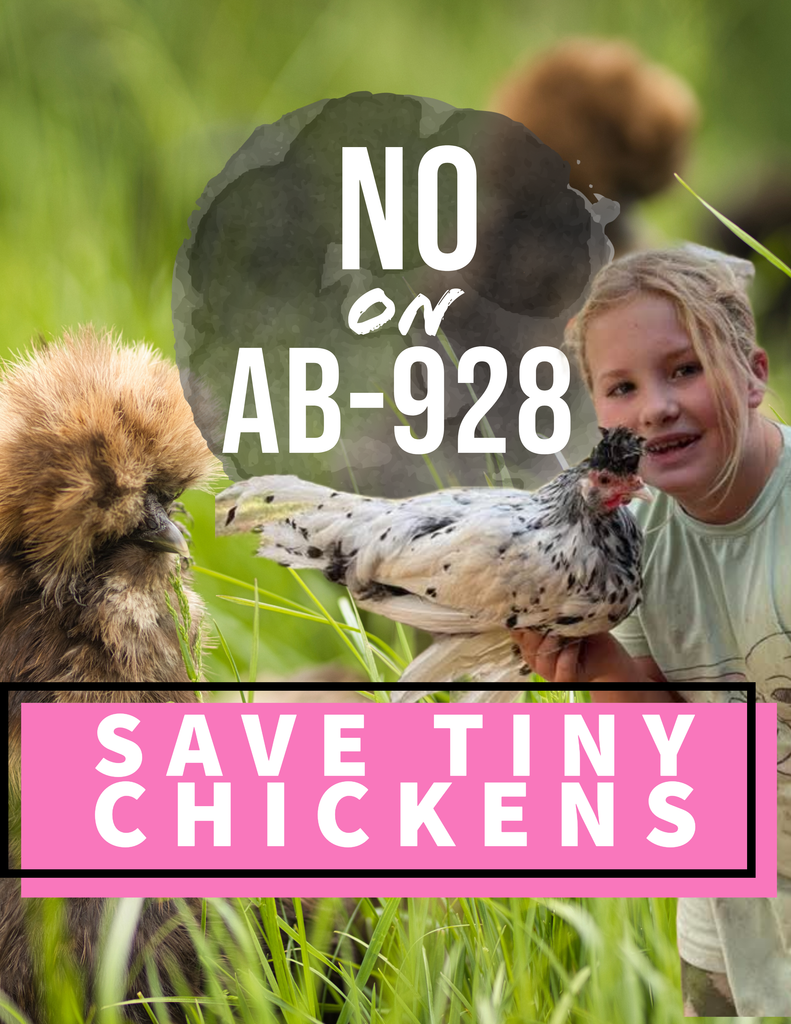
My first encounter with AB 928 was a simple graphic on my Facebook feed. I have no idea where it came from or who shared it, but it was concerning enough that I looked up the bill.
What I found was worse than the graphic had indicated.
I made my own graphic, shared it on my Facebook page and then posted it in every local poultry and homesteading group I could find.
It generated a flurry of activity, much of it disappointing and unexpected.
Many chicken people couldn’t imagine why anyone would need more than a single rooster to protect their hens. Many incorrectly believed the bill didn’t apply to them. Others assumed one of the exemptions would protect legitimate breeders.
I wasn’t so sure.
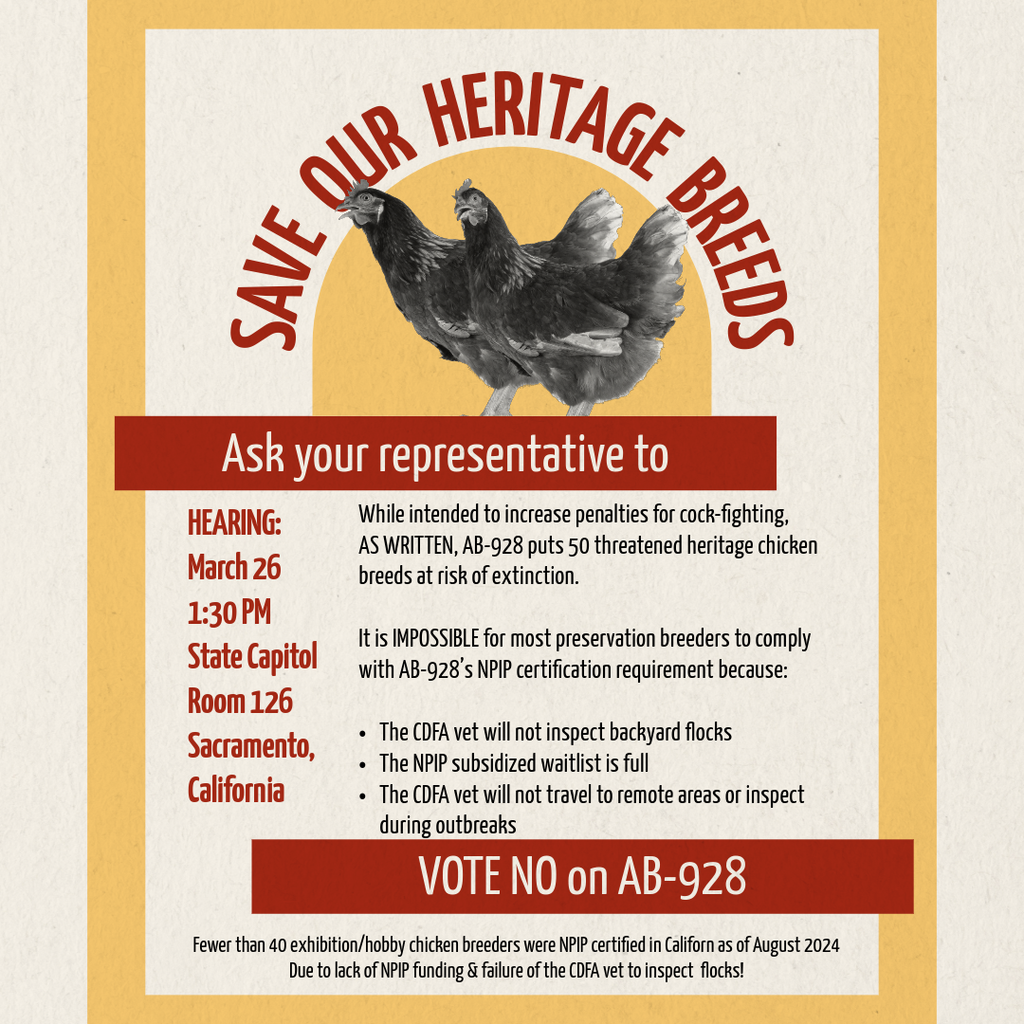
One exemption required breeders to become certified through the National Poultry Improvement Plan (NPIP), so I started making phone calls to find out what it would actually take to comply.
What I found was a system that couldn’t support the requirement being proposed.
For a flock of 60 chickens, the estimated certification would cost about $1,020 a year. There were only three authorized testing agents in California. The veterinarians listed by the California Poultry Federation didn’t make farm calls. And certification required an onsite inspection by a regional CDFA veterinarian, but I was told CDFA didn’t have the resources to conduct those inspections.
In other words, the bill was offering breeders an exemption that many of them couldn’t practically obtain.
I put what I’d learned into a white paper, along with changes that could make the exemption workable. Among other things, I proposed training more authorized agents, processing the existing backlog, increasing funding for small-flock certification and ensuring that applicants could actually receive the required inspections.
I met with people I already knew who were planning to attend the Assembly Agriculture Committee hearing. They selected me to speak on behalf of the group, and I wrote a letter that I hand-delivered to each member of the committee before the hearing.
INSIGHT
Then I went to the Capitol.
When I walked into the Capitol building to oppose AB 928, I had no idea what to expect. The last time I’d been there, I was a kid touring the place. There were more people than I expected.
When it came time for the opposition to speak, the committee called on two women none of us knew.
Things grew tense.
People around me were asking who these women were. Why were they speaking for us? Who had selected them?
Apparently, they had simply gotten there first and talked to the clerk, but no one knew that at the time.
Before we’d even begun to fight the bill, I could see the opposition beginning to fracture.
After they spoke, forty-three people stood in line to register their opposition.
Then the committee began asking questions.
Assemblymember Rogers made statements about what the bill would and would not do that did not match the language I had spent the previous days researching. It seemed as though the bill’s own author didn’t fully understand its practical implications.
To my dismay, the committee voted to pass it, accompanied by an ambiguous promise that Rogers would make sure people raising chickens for legitimate purposes were protected.
I walked into that hearing thinking the problem was the bill.
I walked out realizing we had a second problem: the process itself.
Bills could move through committee based partly on amendments and assurances that hadn’t happened yet. The language could change immediately before a hearing. An argument that was accurate and important today might no longer apply to the version being considered tomorrow.
Meanwhile, the people trying to oppose the bill were working from different versions, different interpretations and different levels of understanding.
If we were going to have any chance of being effective, we needed a way to keep people informed in real time.
Vision
So we built one.
After the hearing, everyone spilled into the hallway.
Passions were high, but there was no unity. People were angry about the bill, angry about what had happened in the hearing and suspicious of one another.
We were in danger of dismantling our own movement before it had really begun.
Worse, many of the people who had shown up to oppose AB 928 didn’t fully understand what was in it.
So I approached the two women who had spoken. Instead of fighting over who was supposed to represent whom, we started talking about what the opposition actually needed.
I said we needed a Facebook group.
They created California Opposed to AB 928 that evening, and a dream team was born.
I immediately started posting information to the group.
- Fact sheets.
- Video analyses.
- A crash course in the legislative process.
- Where we were in that process.
- What was going to happen next and, most importantly,
- what people could actually do.
We also had a credibility problem to solve.
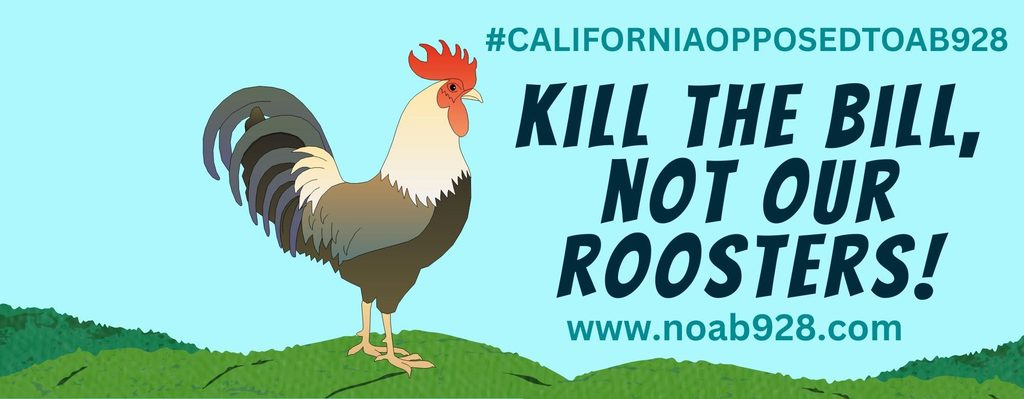
Opposition to restrictions on rooster ownership could easily be dismissed as opposition from cockfighters. To join the group, prospective members had to answer screening questions, including affirming that they were not involved in cockfighting.
The group grew rapidly to more than 1,500 members.
But the number wasn’t really the important part.
For the first time, we had a place where someone could arrive confused or frightened by something they’d heard about AB 928 and leave understanding what the bill actually said, what had just happened, what was likely to happen next and where they could be useful.
That became the foundation for almost everything that followed.
The Plan
Understanding the bill was only the beginning.
The more we learned, the more complicated the problem became.
Every change to the bill had consequences for different people. An exemption that worked for one breeder might do nothing for another. Language that sounded reasonable on its face could become almost impossible to comply with once you followed it all the way through.
So we kept following things through.
We collected information from breeders. We surveyed people about why they kept poultry and how proposed restrictions would affect them. We talked with agricultural organizations, conservation people, cultural communities, lobbyists and others who understood pieces of the problem better than we did.
We worked on proposed amendments.
We researched costs.
We mapped legislators and districts.
We developed talking points for different audiences.
And we corrected ourselves when we got things wrong.
That last part mattered.
Passionate people were spreading inaccurate information about the bill. Sometimes it was because they were working from an old version. Sometimes they misunderstood the language. Sometimes they were confused because changes we were discussing with the bill’s sponsor had not yet been added to the version going up for a vote.
But if we wanted legislators to take us seriously, we couldn’t afford to be sloppy with the truth just because the truth was less dramatic.
The goal wasn’t to prove that AB 928 was terrible.
The goal was to understand exactly where it created problems, for whom, and why.
That distinction changed the way we worked.
Not everybody needed the same reason to care.
One of the things that became increasingly obvious was that there was no single “poultry community.”
People kept roosters for very different reasons.
For some, they were part of a religious or cultural practice.
Some had spent decades developing exhibition lines.
Some were preserving rare breeds.
Some had birds that had been in their families for generations.
Some were homesteaders producing food.
Some were young people who had started in 4-H or FFA and wanted to continue breeding after they aged out.
These people didn’t need to become more alike.
They needed legislation aimed at cockfighting to recognize that there were many legitimate reasons to own and house roosters individually that had nothing to do with cockfighting.
Once we understood that, we asked:
Who is the right person to explain each part of this?
The bill had a long list of organizations supporting it and very little formal opposition.
We set out to change that.
We contacted poultry organizations, businesses and feed stores, asking them to submit formal opposition. We spoke with the American Poultry Association, the American Bantam Association, a board member of the Livestock Conservancy and regional poultry clubs.
We also ran into obstacles.
For example, 4-H leaders couldn’t simply speak in opposition on behalf of 4-H. The organization’s relationship with the state limited what they could do in an official capacity.
We needed to understand what each organization and community could contribute, and where its constraints were.
One of the members of our Facebook group was Hmong and lived in Sacramento. We asked him to help us understand why the issue mattered to his community.
Then we asked him to help us find other people.
He got a local feed-store owner involved.
And then they took it from us.
The feed-store owner became a leader in the opposition. They held events at the store. He shared videos in Hmong and English. People came to the Capitol in traditional dress. They organized within their own community and talked about the issue in their own way.
They didn’t need me to run it.
They needed good information, a way into the process and enough room to make the issue theirs.
what happened
Then 318 people showed up.
At the same time we were working on educating the opposition to the bill, the American Society for the Preservation of Gamefowl (APG) was seriously organizing.
They hired a lawyer to speak in opposition and bussed people in from up and down the state.
At the April 8 Judiciary hearing, 318 people were recorded as opposing the bill.
That is a lot of people to get to the Capitol on a weekday over a chicken bill.
The committee passed it anyway.
Three weeks later, we did it again.
APG pulled out all the stops and got an estimated 600 people to show up, stand in line and put their names on the record in opposition. They also organized a press conference. Univision and Fox covered it. We heard they had hired a lobbyist.
The bill advanced again.
At some point you have to stop congratulating yourself for working hard and ask whether the work is working.
We had hundreds of people showing up.
We had passion.
We had organizations opposing the bill.
We had media attention.
And we were still losing votes.
So the question changed.
It wasn’t:
How do we get more people to care?
It was:
Why isn’t all of this effort changing the outcome?
We did get some results. And that created another problem.
It wasn’t that all our efforts were failing.
We were getting changes made to the bill.
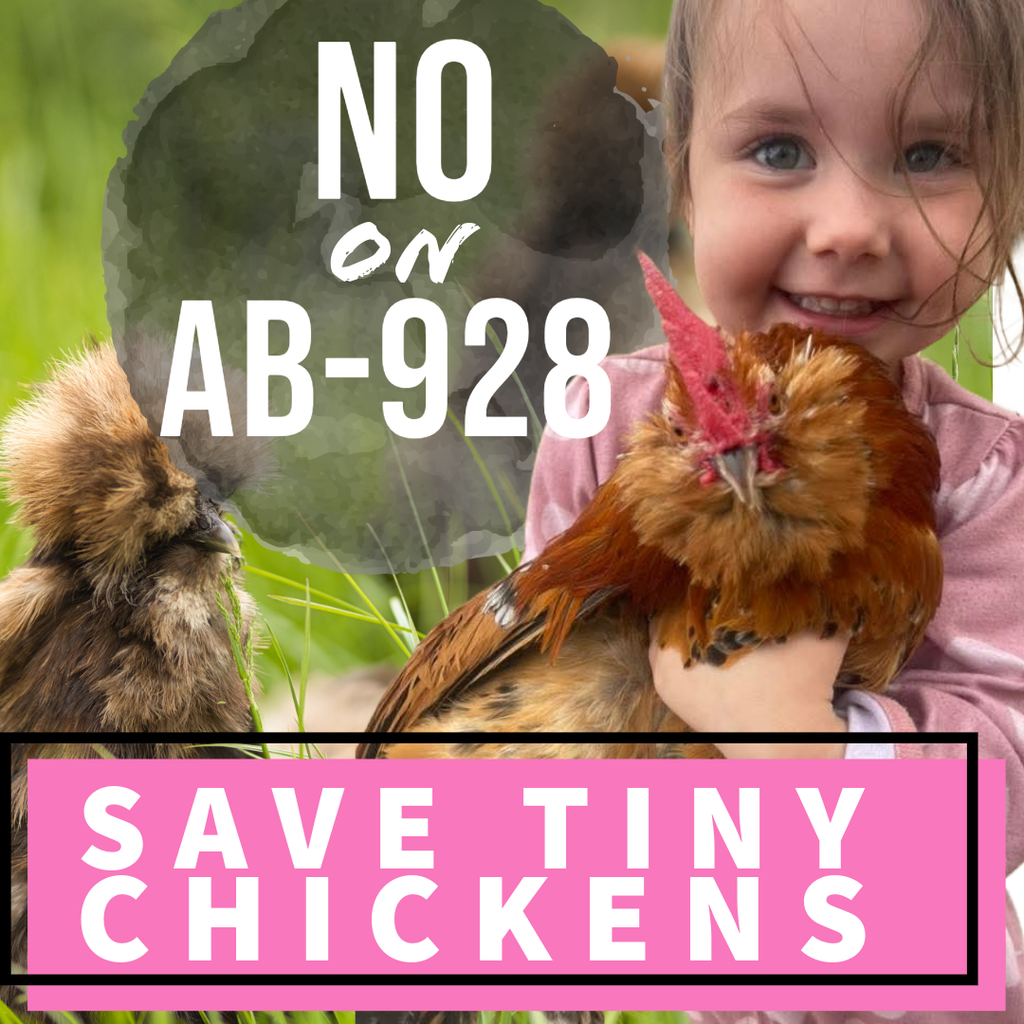
The Save Tiny Chickens effort helped secure an exemption for bantams. The proposed rooster limit increased from three per acre to twenty-five. Another provision was narrowed by adding the words “that are movement constrained.”
Each change mattered.
Each one reduced the number of people who would be affected by the legislation.
That was exactly what we had been trying to accomplish.
But there was an unintended consequence.
The opposition wasn’t a single group with a single objective. Exhibition breeders, homesteaders, cultural communities and gamefowl owners had different concerns. As amendments addressed some of those concerns, the people who had been most motivated to fight the bill no longer faced the same threat.
We were making the legislation less harmful to some poultry owners while potentially reducing the number of people willing to oppose it.
And not everyone appreciated the compromises.
APG had invested tremendous resources in organizing opposition. Its members were still deeply concerned about the bill. Changes that protected other categories of poultry owners didn’t necessarily address their concerns, and those changes created friction within the broader opposition.
From their perspective, people who had stood alongside them were negotiating their way out of the problem while leaving others behind.
From ours, protecting legitimate poultry owners was the objective. If we could get language changed so fewer people were harmed, we needed to pursue that opportunity.
Neither position made the tension disappear.
And there was another complication.
A legislator could point to the amendments as evidence that concerns were being addressed, even when significant problems remained. The more exemptions we secured, the easier it became to suggest that the bill had been fixed.
We were accomplishing part of what we’d set out to do.
But every success changed the political landscape in which we were working.
The same changes that made the bill less damaging could also make the remaining opposition less powerful.
And all that effort wasn’t enough.
By then, I was beginning to understand something uncomfortable about the legislative process.
A strong argument wasn’t necessarily enough.
I watched legislators leave hearings, look at their phones and sometimes appear barely engaged with the testimony being presented. Amendments could be discussed without appearing in the version of the bill being considered. Committees could advance legislation on assurances that problems would be addressed later.
And legislators had relationships and priorities of their own.
Everyone had bills they wanted passed. There seemed to be an understanding that opposing a colleague’s legislation could have consequences for your own.
I couldn’t prove what motivated any individual vote, but it was increasingly apparent that the merits of our arguments were only one part of the decision.
We didn’t have the political capital to make people pay attention simply because we were right about a problem.
That didn’t mean the work was pointless.
It meant we needed to understand the constraints we were operating within.
We repeatedly suggested that, rather than impose restrictions affecting law-abiding poultry owners, the Legislature could increase penalties for cockfighting.
We were told that approach was politically unacceptable because of concerns that it would be perceived as racist.
Meanwhile, I was working closely with a Farm Bureau lobbyist and representatives of Humane World for Animals to find amendments that would protect legitimate poultry fanciers.
We had organizations prepared to withdraw their opposition if the bill was changed appropriately.
That was a real opportunity for compromise.
But the amendments we had discussed before the Appropriations hearing weren’t published in time.
Then we learned that the expectation wasn’t simply that the Farm Bureau, the American Poultry Association and our Facebook group would withdraw opposition.
We were expected to endorse the bill.
We weren’t willing to do that.
And the language we remained concerned about was still in the bill, despite assurances that legitimate poultry fanciers wouldn’t be affected.
The problem wasn’t that nobody had tried hard enough.
It was that effort, expertise, public participation and even negotiated agreement didn’t necessarily translate into the decision we wanted.
We had to work within a system whose incentives and relationships we couldn’t control.
Then we met the lobbyists.
APG and our group had some crossover. Many APG members were highly involved in our group, but there was no coordination between leadership.
Then APG reached out and asked a few of us to participate in a lobby day at the Capitol, led by the lobbyist they had hired, Marc Aprea.
We were there to represent exhibition poultry and our Facebook group, and to provide women’s perspectives in a delegation otherwise closely associated with gamefowl interests.
Before lobby day, we were asked to participate in a strategy call to go over the talking points prepared by the lobbying team.
The talking points were good, but they didn’t quite capture the implications of the bill for groups beyond APG. Some of the nuances of the bill were missing.
After listening, I spoke up.
I pushed back on some of those details and explained why they mattered.
That’s how I ended up on the team with the most important meetings of the day.
APG and its lobbying team divided into four groups and spent the day meeting with the offices of about thirty Assemblymembers.
Marc had prepared paragraphs for us. The plan was basically that he would lead and the rest of us would deliver our assigned pieces.
The first meeting was awful.
The staffer was nice enough, but we were losing her. You could see it.
So toward the end, I pulled out some things I had brought with me and went off script.
I talked about beautiful breeds of chickens that most people don’t even know exist—and the possibility of losing them forever.
That she understood.
When we walked into the next office, Marc asked me to start.
And that more or less became the pattern for the rest of the day.
Marc knew Sacramento in a way I absolutely did not. He knew the people, the politics, the process and how to get us into rooms I couldn’t have gotten into myself.
What I had was different.
I understood the problem well enough to recognize when the explanation wasn’t working and find another way into it.
After that day, Marc started calling me.
A lot.
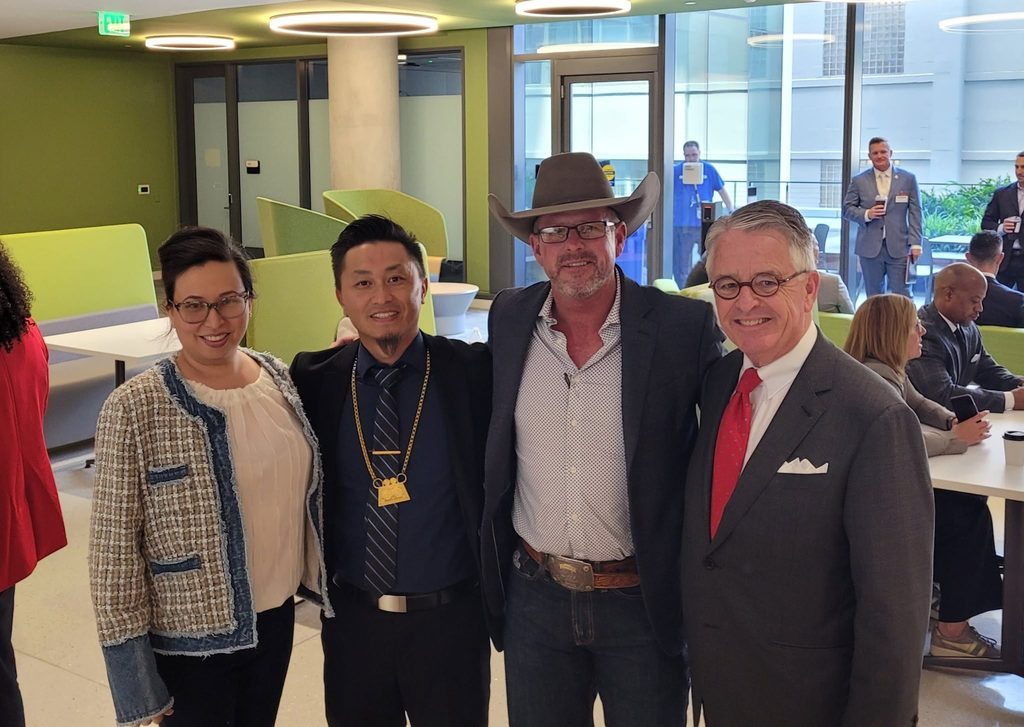
I didn’t need to become the lobbyist.
And I didn’t need to become the Hmong community leader.
I didn’t need to become the person who could organize hundreds of poultry people and get them to Sacramento.
Those people already existed, and many of them could do those things far better than I could.
The useful question was:
What does this system already have that we aren’t using very well?
Who knows something we need to know?
Who has access we don’t have?
Who can reach people we can’t reach?
Who has credibility with an audience that doesn’t know me from Adam?
Who is capable of taking responsibility for part of the problem if they have the information and opportunity to do it?
The more those people took ownership, the less important it became for us to be involved in everything.
That was a feature, not a failure.
We didn’t kill AB 928.
I want to be very clear about that.
The bill passed the Assembly 46–15 in June 2025.
Its first Senate policy hearing was scheduled for July 1. The official legislative history says the hearing was canceled at the request of the author.
Then nothing happened for almost eleven months.
We believed the opposition had something to do with that. I can’t prove why the author canceled the hearing, so I’m not going to claim we did.
The bill came back in 2026.
By then, we weren’t materially involved anymore. I didn’t attend a single hearing or meeting that year.
Other people kept going.
The bill eventually made it to Senate Appropriations, where it was held under submission in August 2026.
And frankly, I like that ending better for this story.
Because if the measure of our contribution were whether everyone still needed us a year later, we would have designed a pretty lousy system.
They didn’t.
Field Note
Change the game.
There is a particular kind of problem I keep running into.
It sounds like this:
Everything would be so much better if these people would just ________.
Work harder.
Follow the process.
Take responsibility.
Show up.
Stop doing that.
Start doing this.
We usually attack those problems from one of two directions.
We try to control people from the top down.
Or we try to inspire them from the bottom up.
Sometimes either of those things is appropriate.
But I’m usually more interested in the space around the people.
What information do they have?
What don’t they understand?
What is unnecessarily difficult?
Where is effort being wasted?
Who is carrying responsibility that somebody else could carry?
Whose skills aren’t being used?
What does the current system accidentally reward?
What resources are already there that nobody is using?
And what is consuming the time, money, attention or human capital we need to actually succeed?
Because efficiency isn’t just about doing something faster or cheaper.
Sometimes efficiency is what makes effectiveness possible.
A system can have enough people, enough money, enough expertise and enough enthusiasm and still fail because it burns those resources faster than they can produce the desired outcome.
AB 928 had no shortage of effort.
The question was how to turn all that effort into something useful.
Sometimes that means moving something.
Sometimes removing something.
Sometimes connecting two people who weren’t connected before.
Sometimes giving someone better information.
Sometimes putting responsibility somewhere else.
Sometimes discovering that the intervention everyone is working so hard to execute isn’t solving the right problem in the first place.
When an outcome depends on people behaving differently, it’s tempting to start by trying to change the people.
I usually start somewhere else.
What is it about the game they’re playing that makes their current behavior make sense?
Change that, and people can surprise you.